
Labral tear without FAI
The labrum can also tear without FAI being present: for example, through a fall, a twisting injury to the hip during sport, or repeated microscopic overload. In these cases too, a hip arthroscopy can help, either by repairing the labrum with stitches or, if the tissue is too damaged, by removing the torn part.
Cartilage damage
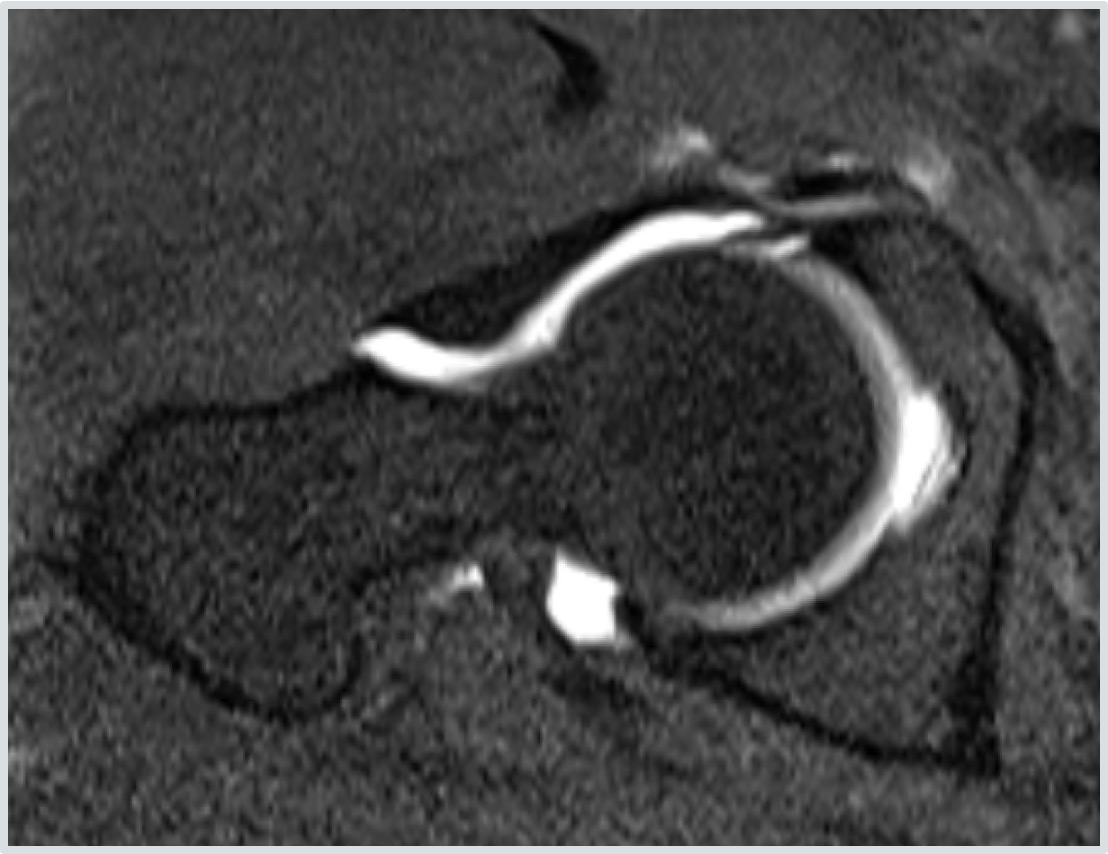
Cartilage can become damaged as a result of trauma, FAI, or in combination with a labral tear. Because cartilage barely repairs itself, loose cartilage edges can be smoothed during the operation, or a microfracture technique can be used for a small defect: tiny holes are made in the underlying bone to stimulate the formation of scar tissue that partly takes over the function of cartilage. In cases of (early) osteoarthritis of the hip joint, a hip arthroscopy is not the right treatment. Cartilage damage regularly occurs together with FAI, particularly with the cam variant — read more on the page about FAI.
Loose bodies
Sometimes a small piece of bone or cartilage breaks loose within the joint. Such a 'loose body' can cause pain, clicking, or a locking sensation. A hip arthroscopy is a good way to remove such a loose fragment.
Hip dysplasia
With hip dysplasia, the hip socket is on the shallow side, so the femoral head receives less support. This can overload the labrum. Hip dysplasia calls for careful consideration: a hip arthroscopy isn't always the best solution, and sometimes a different procedure on the hip socket is more appropriate, such as a Ganz osteotomy — read more on the page about alternatives. You make this decision together with your orthopaedic surgeon — read more on the page about shared decision-making.
When is a hip arthroscopy less suitable?
A hip arthroscopy works best in young people without cartilage damage and with a healthy weight. In the presence of signs of (early) osteoarthritis, cartilage damage to the hip socket, hip dysplasia, a BMI above 25, or an age above 45 years, caution is warranted — the chance of a good result is then smaller. Your orthopaedic surgeon will always discuss this honestly with you, see also informed consent.