
A ball-and-socket joint
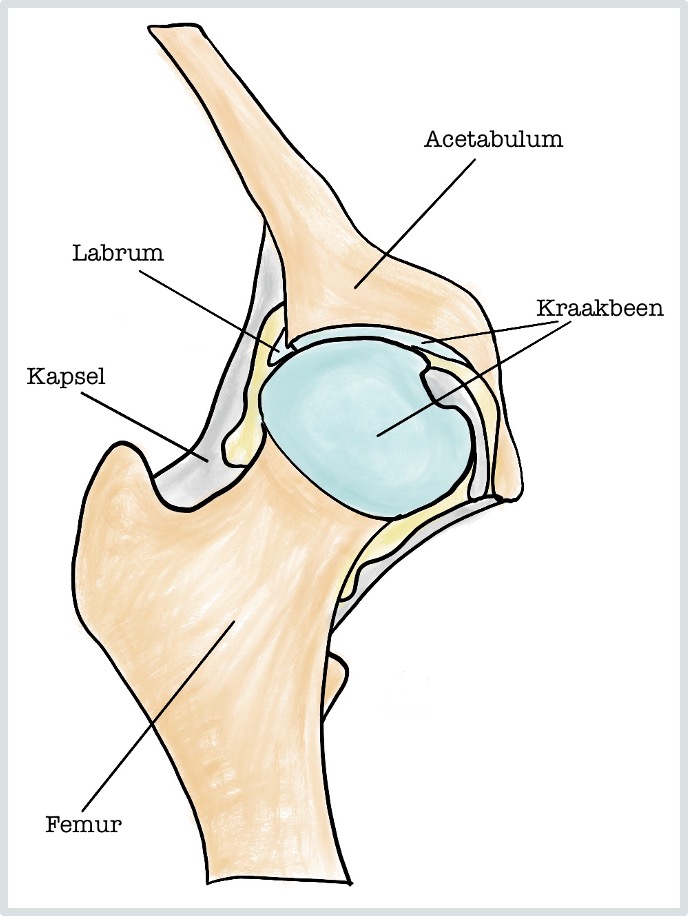
Your hip is a ball-and-socket joint: the round femoral head — the upper end of your thigh bone — rotates within the socket of your pelvis, the acetabulum. This shape allows for a wide range of movement, in almost any direction.
The labrum: the seal of your hip
Around the rim of the hip socket sits the labrum, a ring of fibrous cartilage. The labrum increases the contact area between the femoral head and the hip socket, acts as a kind of suction cup that keeps the joint fluid in place (the 'suction seal'), and contributes to the stability of your hip. The labrum contains nerve endings — so damage to it can be clearly felt as pain.
The labrum has only a limited blood supply. As a result, it does not heal on its own after a tear, unlike, for example, a muscle.
Cartilage and joint fluid
The femoral head and hip socket are lined with a layer of smooth cartilage, which allows for smooth, low-friction movement. Joint fluid lubricates the joint and nourishes the cartilage. Cartilage, too, can barely repair itself once damaged.
Why this matters for your symptoms
Many hip symptoms in young, active people arise because the shape of the femoral head or hip socket differs slightly from average, causing the labrum to become pinched or overloaded.
Cartilage damage: a vulnerable spot
Unlike the labrum, cartilage has no nerve endings. As a result, damage to it often only becomes painful once surrounding tissue, such as the labrum, is also affected. With prolonged impingement — particularly the cam variant — the cartilage at the rim of the hip socket can wear away. Because cartilage does not heal on its own, it's important to have symptoms assessed in good time. Read more on the page about FAI.